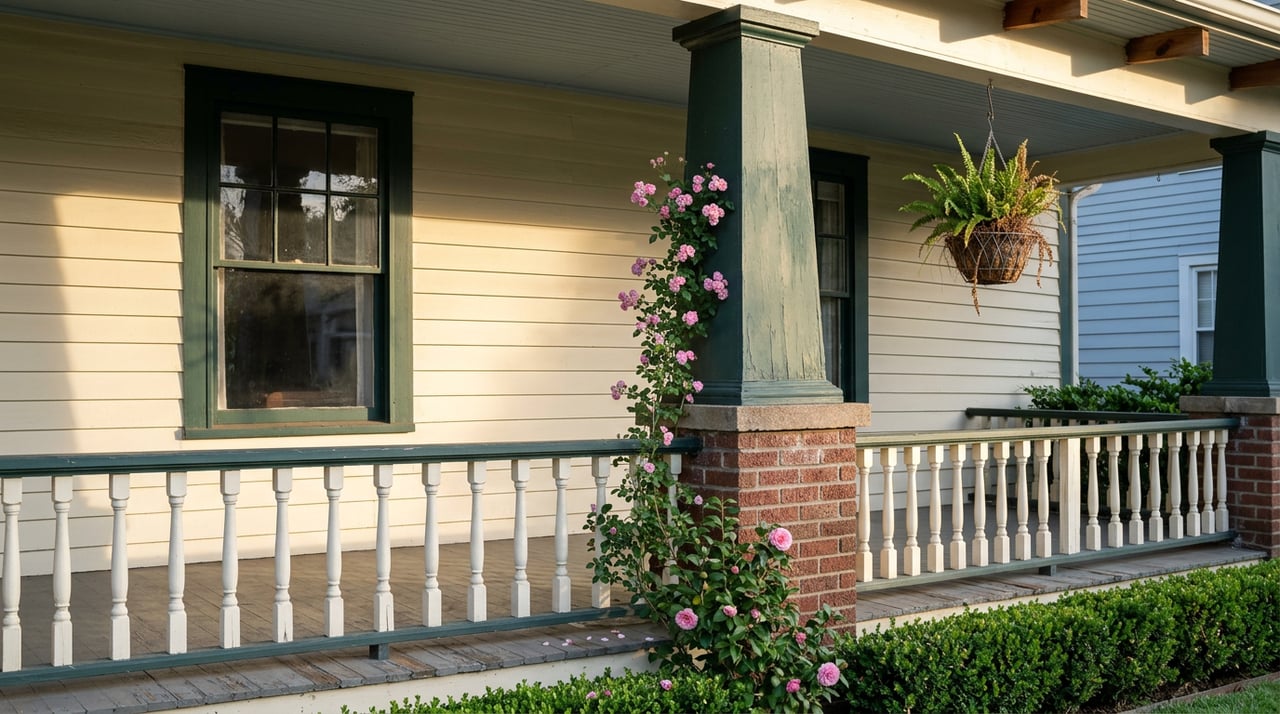
Picture two houses on the same block of 3rd Street in Old Town La Verne. Same era, same craftsman bones, same wraparound porch pitch. One owner spent eighteen months and a design review hearing repainting the trim the wrong shade of green. The other gutted a kitchen, swapped the windows, and added a rear addition with a standard building permit and nothing more. Neither owner broke any rule. They were just standing on different sides of a line most buyers never think to look for, because from the sidewalk the line is invisible.
That gap is the thing worth understanding before you write an offer on a pre-1940s home in La Verne. The city's charm runs deep, all the way back to its founding in 1887 as a Santa Fe Railroad destination, and Old Town's newer infill still echoes the Victorian and craftsman lines that gave the district its character. But charm and legal protection are two different things here, and confusing them can cost a buyer either unnecessary renovation friction or a tax break they never claim.
The Look Isn't the Law
Most Los Angeles County cities with a historic core handle preservation one of two ways: a citywide ordinance with a formal historic preservation overlay zone, or nothing at all. La Verne does neither. According to the Los Angeles Conservancy's community preservation records, the city has no true historic preservation ordinance, yet it still protects identified historic resources through a different mechanism entirely: specific plan areas that function as historic districts with design review attached.
There are currently two of these: the Lordsburg Specific Plan and the Old Town La Verne Specific Plan, adopted in 2013. If your prospective purchase sits inside one of these boundaries, exterior changes go through a design review process before permits are issued. If it doesn't, the house is subject to the same building code as any other home in the city, regardless of how old it looks.
Here's where it gets more specific to La Verne than to almost anywhere else in the region. The Conservancy's records note that there is no historic resource survey covering the entire city. Only one survey exists, and it covers the Old Town area, completed in 1986. That means the city's own knowledge of what qualifies as historic is limited to a single neighborhood and a survey nearly four decades old. A 1910s home two blocks outside that surveyed footprint may look every bit as historic as one inside it, and carry none of the same paperwork.
Landmark Status Is Something an Owner Chooses
The second piece changes how a buyer should think about risk versus opportunity. Individual properties in La Verne can be designated as local landmarks, but only by council resolution, and nominations can come from either the property owner or the city itself. The catch: city-initiated nominations are limited to commercial buildings, and even those require the owner's consent.
In plain terms, nobody can land a residential property in a protected historic status against the current owner's wishes. Landmark designation on a house is opt-in. If the seller never filed for it, the home almost certainly doesn't have it, no matter how many original details survived a century of ownership turnover.
This cuts both ways for a buyer. On one hand, it means renovation flexibility on an older Old Town home is often wider than someone coming from a city with a blanket HPOZ would assume. There is no district-wide "Contributing" designation automatically limiting your window replacements or roofline changes the way there would be in a city with a formal historic district ordinance. On the other hand, it means you can't assume protection or benefits are already baked in just because the house is old. You have to check the specific parcel.
Why This Changes the Tax Conversation Too
The financial upside of historic status in California runs through the Mills Act, a state law that lets cities offer property tax relief in exchange for an owner's commitment to maintain and restore a qualified historic property. La Verne is one of the minority of Los Angeles County jurisdictions that has actually implemented a Mills Act program, according to the Conservancy's list of participating cities, which also includes Claremont, Pasadena, Glendora, and San Dimas among others.
The benefit only attaches to a property that carries an actual designation, either as a local landmark or as a recognized contributor within one of the specific plan districts. Age and appearance don't qualify a home on their own. A buyer who assumes an Old Town craftsman automatically comes with Mills Act eligibility, or automatically excludes it, is guessing. The only way to know is to ask the city's Community Development Department whether a contract already exists on the parcel, and if not, whether the property would even be eligible to apply.
That verification step matters more here than in a city with a single, well-documented historic district, because La Verne's patchwork of one old survey, two specific plans, and an opt-in landmark process means the answer genuinely varies house to house rather than block to block.
What This Looks Like at the Offer Stage
For a buyer circling a specific Old Town or Lordsburg-area listing, the practical checklist looks different from a standard purchase:
Confirm with the city whether the parcel sits inside the Old Town La Verne Specific Plan or the Lordsburg Specific Plan boundary, since that determines whether exterior work requires design review before it requires a building permit.
Ask whether the property has ever been nominated for or granted local landmark status, since that designation is what would trigger both design review obligations and Mills Act eligibility, and it won't show up just because the home looks period-appropriate.
Check for an existing Mills Act contract recorded against the property. If one exists, it transfers with reduced property tax obligations tied to ongoing maintenance commitments, which is a benefit worth confirming rather than assuming.
Separate exterior scope from interior scope in your renovation planning. Design review in specific plan areas typically governs what's visible from the street. What you do inside the walls is a different conversation with the building department.
None of this shows up on a listing sheet. It shows up in a phone call to the city, and it's worth making that call before the inspection contingency deadline rather than after close, especially if your renovation plans include anything visible from 3rd Street or Bonita Avenue.
The Neighborhood Around the Question
None of this is abstract for the people who actually live along D and Third Streets. That intersection is the working heart of Old Town, home to more than a dozen restaurants ranging from date-night spots like Chase's and Café Allegro to the casual, decades-old draw of Warehouse Pizza, with House of Wings and Fourth Street Mill rounding out the block. The city's own Old Town district page lists a full calendar built around that same stretch: the Cool Cruise Car Show, the Sip of La Verne Wine Walk, La Verne on Tap Beer Walk, and the Holiday Stroll each bring people back to D and Third multiple times a year. The Old Town Business Association's advisory board meets quarterly to plan those events and the physical upkeep of the district, currently gathering at Café Wang Restaurant on D Street.
That's the texture a buyer is actually purchasing into when they choose an Old Town address, a walkable commercial core with a real, recurring social calendar sitting a few blocks from housing stock that ranges from early-1900s multifamily buildings to newer craftsman-style infill built to match the district's original lines. The zoning and preservation mechanics matter because they determine what you can do with the house. The restaurants, the wine walks, and the quarterly business meetings are why people want the house in the first place.
A Few Questions Buyers Ask Us Directly
Does buying in Old Town automatically restrict what I can renovate? Not unless the specific parcel carries a local landmark designation or sits within a portion of the Old Town La Verne Specific Plan or Lordsburg Specific Plan that triggers design review for the change you're planning. Confirm status with the city before assuming either way.
Can I apply for Mills Act status after I close, if the current owner never did? The path runs through the same city process regardless of when you buy. A new owner can pursue landmark designation and a Mills Act contract after close, but it isn't automatic and isn't guaranteed, so it should be treated as a future possibility to research rather than a built-in benefit of the purchase.
How do I find out if a house I'm considering already has protected status? Contact La Verne's Community Development Department directly and ask about the parcel's status relative to the specific plan boundaries and any existing landmark resolution or Mills Act contract. This is a five-minute question that can save months of renovation planning built on a wrong assumption.
If you're weighing an Old Town bungalow, a Lordsburg-area craftsman, or any older La Verne home where the paperwork and the porch don't obviously match, Camden McKay Realty can help you get the parcel-specific answers before you're locked into a contingency clock. Get in touch with Michael and Lisa Mucino to schedule a free neighborhood consultation or sign up for local market updates.