Wondering how to tell a true Claremont Craftsman from a ranch with mid-century touches? In Claremont, that question matters more than you might think because the city was built in layers, and each neighborhood reflects a different era, scale, and architectural rhythm. If you are buying, selling, or simply narrowing your search, understanding those patterns can help you compare homes more confidently and spot what gives each property its character. Let’s dive in.
Why Claremont Has Distinct Home Styles
Claremont is a built-out city with more than 30 distinctive neighborhoods, and the city’s design guidelines note that each area reflects a different era, streetscape pattern, and scale. Because Claremont grew slowly after its 1887 founding, it has relatively few 19th-century homes, a strong early-20th-century bungalow presence, and then a broad wave of postwar ranch and modern development.
That means you are not just shopping by square footage or bedroom count in Claremont. You are often choosing between very different design periods, lot patterns, garage placement, and renovation paths.
Where Craftsman And Mid-Century Homes Appear
Historic Claremont For Craftsman Homes
Historic Claremont is the city’s oldest neighborhood and sits south of Foothill Boulevard around the Village and Pomona College. According to the city, homes there were built between the 1890s and 1940s, and the area includes Victorian, Craftsman, and Spanish Colonial Revival examples.
If you are drawn to porches, wood detailing, and early bungalow character, this is one of the first areas to study. The neighborhood setting also matters here, with tree-lined sidewalks, alleys for rear garage access, and a streetscape where rooflines, porch depth, and window patterns help define the block.
Old Claremont And Transitional Styles
Old Claremont was the city’s first major residential expansion after Historic Claremont. It developed mainly between the 1920s and 1950s and includes single-story homes with Modern, Spanish, Tudor, Ranch, and other revival styles.
This area can appeal to buyers who want older Claremont character but a broader mix of architecture. University Circle, within Old Claremont, dates from 1938 to 1951 and shares a common architectural language that gives the area a more unified feel.
Chaparral For Ranch And Some Mid-Century
Chaparral, south of Baseline Road, was developed by Lewis Homes in the 1960s and 1970s. The city identifies California Ranch as the dominant style there, with some mid-century modern homes also present.
If you like postwar layouts and a more suburban feel, Chaparral is a useful reference point. The nearby homes along Blaisdell Drive, known as Faculty Row, are especially notable for their mid-century modern character.
Claraboya And Padua Hills For Stronger Mid-Century Design
Claraboya, accessed from Mountain Avenue north of Baseline, was built in the early 1960s as a hillside neighborhood of terraced homes with views. The city specifically highlights distinctive mid-century architecture there.
Padua Hills and Palmer Canyon stand out for architect-designed modern houses. The city notes that Richard Neutra designed two homes in Padua Hills, and that post-and-beam construction with floor-to-ceiling glass walls influenced many other homes in the area.
What Defines A Claremont Craftsman
In Claremont’s official style guide, Craftsman homes were most popular from 1900 to 1925. They grew out of the Arts and Crafts movement, which emphasized handcrafted materials and simple detailing.
In practical terms, a Claremont Craftsman often includes:
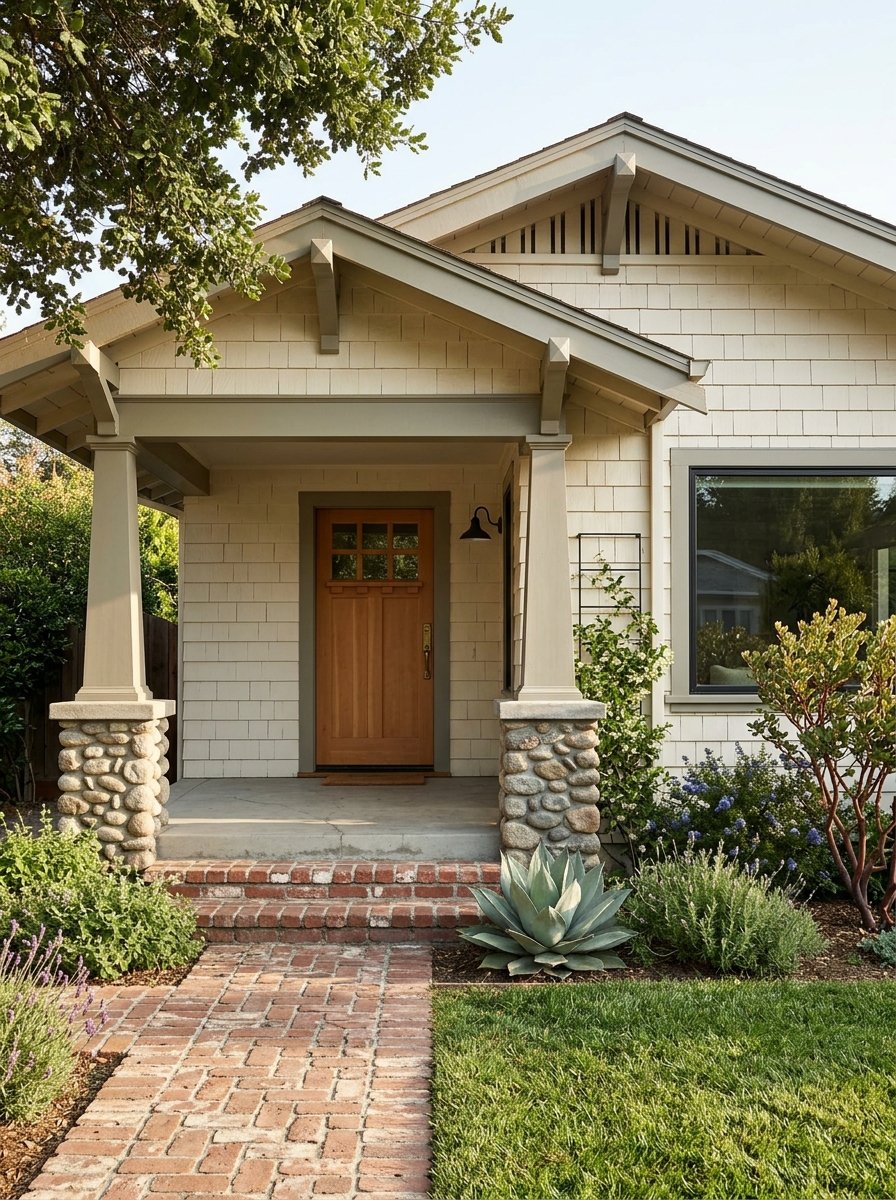
- Prominent front porches
- Low-pitched gabled roofs
- Wide eaves
- Exposed rafters
- Wood shingle or clapboard siding in earth-toned finishes
- Square or tapered porch columns
- Detached side- or rear-yard garages
Some Claremont Craftsman homes also blend in details from Colonial, Spanish, Shingle, Chalet, Pueblo, or Asian-influenced design. That is one reason two homes from the same era can feel similar at first glance but still have very different personalities.
Bungalows Versus Full Craftsman Homes
Claremont also has many early-1900s bungalow homes that came before the fuller Craftsman examples. The city describes these houses as simple one-story or one-and-a-half-story homes with rectangular plans, centered entries, pedimented porch entries, partial or full-width porches, classical columns, and detached garages.
If you are touring homes, it helps to think of bungalows as part of the same early Claremont story, but often simpler in form and detailing. A bungalow may still offer historic charm, just with a more restrained look.
What Defines Claremont Mid-Century Homes
Mid-century in Claremont often overlaps with ranch design, but not every ranch is truly mid-century modern. The distinction usually shows up in how strongly the home leans into modern architectural ideas.
Claremont’s ranch homes are typically one-story, wide rectangular houses with simple U-shaped or L-shaped plans, integrated or attached garages, low-pitched roofs, broad eaves, recessed entries, open interior layouts, large windows, sliding glass doors, and patios or decks. These features reflect the postwar shift toward casual indoor-outdoor living.
Mid-Century Modern Details To Look For
Claremont’s more architectural modern houses tend to include:
- Flat or very low-pitched roofs
- Wide boxed overhangs
- Smooth wall surfaces
- Long ribbons of windows
- Floor-to-ceiling glazing
- Post-and-beam construction
These homes often feel more design-forward than a standard ranch. In Claremont, the stronger mid-century modern character tends to show up in architect-driven hillside or faculty-adjacent pockets such as Claraboya and Padua Hills, while more suburban postwar areas often read as ranch or ranch-plus-modern.
How To Read The Neighborhood Context
One of the most useful things to know about Claremont is that the setting around the home can tell you almost as much as the facade. In older areas, rear garage access, narrow sidewalks, mature trees, porch depth, and repeating rooflines are part of the neighborhood character, not just background details.
In postwar neighborhoods, the clues shift. Wider lots, attached garages, horizontal massing, and stronger patio connections tend to support ranch and mid-century living patterns.
For buyers, this matters because two homes may offer similar living space but very different experiences over time. One may prioritize preserved architectural detail and historic context, while another may offer a more open layout and easier alignment with postwar design updates.
Touring Tips For Craftsman Buyers
When you tour a Craftsman or bungalow in Claremont, focus on the features that carry the home’s original identity. In many cases, those details are central to both character and long-term value.
Ask questions like these:
- Which original features still survive, such as porch posts, exposed rafters, built-ins, wood windows, or stone and brick foundation work?
- Has an addition changed the roofline or porch depth?
- Is the garage detached?
- Is the property on the city’s Register of Structures of Historical and Architectural Merit?
Touring Tips For Ranch And Mid-Century Buyers
With ranch homes, pay attention to whether the features that make the style work are still intact. Open-plan living spaces, picture windows, sliders, patios, and the original low horizontal roofline all shape the design.
For a mid-century modern home, look closely at original glass walls, post-and-beam details, and window groupings. In hillside areas, it is also smart to ask whether additions preserved views and respected the home’s terraced setting.
Helpful questions include:
- Are the open living spaces and indoor-outdoor connections still intact?
- Was the attached garage part of the original design?
- Has remodeling preserved the low roofline and broad eaves?
- Have interior changes weakened the original architectural flow?
Renovation And Permit Considerations In Claremont
If you are buying with future improvements in mind, Claremont’s local rules deserve attention early. The city’s guidelines say alterations should minimize changes to distinctive materials, features, spaces, and spatial relationships, and new work should remain compatible with the home’s size, scale, and massing.
For older homes, that means original windows, porch details, roof form, and garage placement may be more important than they first appear. These are often defining elements of the property’s character.
The city also notes that its Design Review Packet applies to new construction, exterior modifications, building relocations, changes in site features, landscape review, and signs. If a property is on the city’s historic register, Claremont also uses a demolition-delay ordinance for listed properties.
Planning Ahead For Updates
Owners considering future improvements may find added value in understanding local programs. Claremont says Mills Act contracts can provide substantial property-tax savings for qualifying historic properties.
The city’s ADU program also includes pre-approved Craftsman and California Ranch exterior styles. That can be helpful if you want an accessory unit that feels visually consistent with the main house.
Landscape choices matter too. Claremont’s guidelines encourage native, drought-tolerant planting that complements the structure, along with drip irrigation and low-voltage LED lighting.
Which Style May Fit You Best
If you love front porch presence, early architectural detail, and established streetscapes, a Craftsman or bungalow may be the better fit. These homes often reward buyers who value original materials, neighborhood continuity, and a strong sense of era.
If you prefer open layouts, large windows, patio connections, and a more horizontal feel, ranch or mid-century homes may make more sense. And if architectural design is a major priority, the hillside and architect-influenced pockets of Claremont deserve a closer look.
The key is to match your priorities to the neighborhood pattern, not just the listing photos. In Claremont, style and setting are closely tied, and that is what makes the city so interesting to compare.
If you want help narrowing down Claremont neighborhoods by architecture, lifestyle, and renovation goals, connect with Michael Mucino for practical local guidance and a more informed home search.
FAQs
What areas of Claremont have the most Craftsman homes?
- Historic Claremont is one of the main areas for Craftsman homes, especially south of Foothill Boulevard around the Village and Pomona College, where the city says homes date from the 1890s to the 1940s.
What areas of Claremont have the strongest mid-century character?
- Claraboya, Padua Hills, Palmer Canyon, and parts of Chaparral are key areas to watch, with Claraboya and Padua Hills standing out for stronger mid-century and modern design.
What features define a Claremont Craftsman home?
- Common features include a prominent porch, low-pitched gabled roof, wide eaves, exposed rafters, wood siding, square or tapered porch columns, and a detached side- or rear-yard garage.
What features define a Claremont mid-century home?
- Look for flat or low-pitched roofs, wide overhangs, smooth wall surfaces, long window bands, floor-to-ceiling glass, post-and-beam construction, and strong indoor-outdoor connections.
What should buyers ask when touring an older Claremont home?
- Ask which original features remain, whether past work changed the roofline or porch depth, what permits or city reviews were required for prior work, and whether the property is on Claremont’s historic register.
What Claremont renovation rules should buyers understand before purchasing?
- Buyers should review whether the home may be affected by Design Review, historic register status, demolition-delay rules, or compatibility expectations for exterior changes, additions, site features, and landscape updates.